
Dual-Stiffness Nanoparticle Combo Enables Peripheral-Central Dual-Space Drug Delivery for Ischemic Stroke
2026-05-06 | 药学院英文网
Ischaemic stroke is one of the leading causes of death and disability worldwide. The pathological process of ischaemic stroke is complex, involving not only damage caused by local ischaemia and hypoxia in the central nervous system, but also triggering a severe inflammatory response in the peripheral immune system. This creates a feedback loop of progressive disease progression between the central and peripheral nervous systems, which severely impedes endogenous repair. Existing nanomedicine delivery strategies typically employ single-compartment drug delivery approaches to target brain tissue, making it difficult to balance the dual requirements of suppressing peripheral inflammation and promoting central nervous system repair. Furthermore, the highly activated peripheral immune response observed in stroke accelerates the clearance of nanoparticles, significantly reducing their targeting efficiency; this has become a major bottleneck constraining clinical translation.
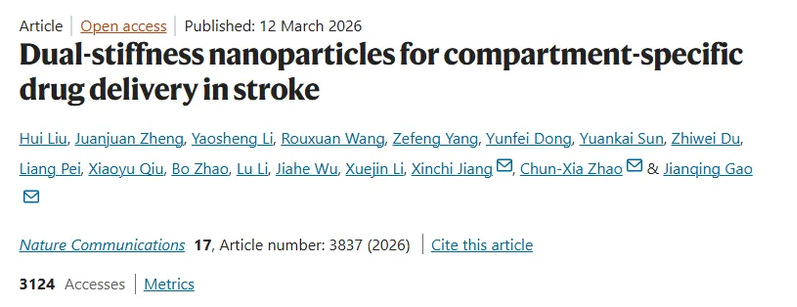
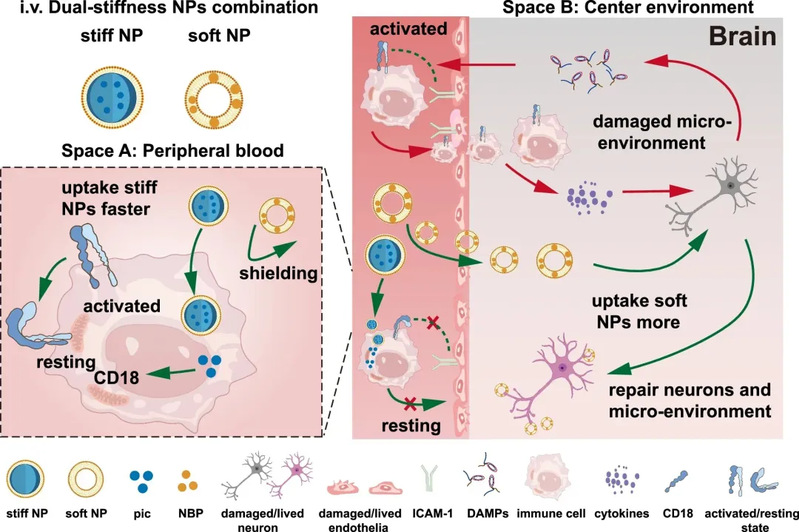
Recently, Professor Jianqing Gao and Research Fellow Xinchi Jiang from the School of Pharmacy Zhejiang University, in collaboration with Professor Chunxia Zhao from the University of Adelaide in Australia, published a research paper titled "Dual-stiffness nanoparticles for compartment-specific drug delivery in stroke" in Nature Communications. The study innovatively discovered that immune cells and neural cells exhibit different uptake preferences for hard and soft nanoparticles, and identified a pattern whereby a combination of dual-stiffness nanoparticles helps protect the soft nanoparticles by reducing their uptake by immune cells. The researchers utilised molecular dynamics simulations, proteomics and cytoskeletal differential analysis to elucidate these mechanisms. Based on these findings, the study proposed a dual-stiffness nanoparticle combination delivery strategy tailored to the dual-compartment therapeutic needs of ischaemic stroke. This strategy ingeniously exploits the stiffness-mediated differences in the biological fate of nanoparticles: hard nanoparticles carry anti-inflammatory drugs to act peripherally, blocking the abnormal infiltration of peripheral immune cells into the brain; whilst the protective effect of the dual-stiffness nanoparticle combination on soft nanoparticles allows the latter to carry neuroprotective drugs, thereby reducing their clearance by peripheral immune cells and enabling them to cross the damaged blood-brain barrier to enter the brain and repair damaged neurons. This achieves a synergistic effect of peripheral inflammation suppression and central nervous system protection, providing a novel paradigm for the treatment of diseases with complex, multi-spatial pathological characteristics.
The platform proposed in this study, which utilises differences in nanoparticle stiffness to achieve dual-space delivery, is not only suitable for ischaemic stroke but also holds broad application prospects for complex diseases such as Alzheimer’s disease and glioma, which similarly exhibit pathological features spanning both peripheral and central systems. This design philosophy of ‘spatial stratification and synergistic enhancement’ has opened up new avenues for the development of precision nanomedicine.
The School of Pharmacy Zhejiang University is the first-listed institution for this paper. Hui Liu, a Master’s student at the School of Pharmacy Zhejiang University, is the first author; Professor Jianqing Gao and Research Fellow Xinchi Jiang from the School of Pharmacy Zhejiang University, and Professor Chunxia Zhao from the University of Adelaide are the co-corresponding authors.
Original link: https://www.nature.com/articles/s41467-026-70340-3
NEWS
-
28
2026.07
-
17
2026.07
-
03
2026.07
-
08
2026.06
-
27
2026.05
-
15
2026.04