
Sensight: A Design Strategy for High-Sensitivity Imaging Tools—From
2026-04-22 | 药学院英文网
Due to their advantages—such as in situ, real-time and dynamic imaging—fluorescent small-molecule probes have become essential tools for tracking biomolecules within living cells, understanding disease mechanisms and developing targeted drugs. However, as most bioactive molecules are present in low concentrations and exhibit high dynamic behaviour, achieving highly sensitive detection within living cells presents considerable challenges. At the same time, the sensitivity of probe-based cellular imaging depends not only on the efficiency of the fluorescent "switch" but is also constrained by a variety of complex factors, such as cellular permeability and probe-instrument compatibility, which interact and limit one another. Consequently, the systematic integration of the multidimensional parameters of fluorescent probes to enable quantitative prediction and rational design of probe imaging sensitivity presents a major challenge.
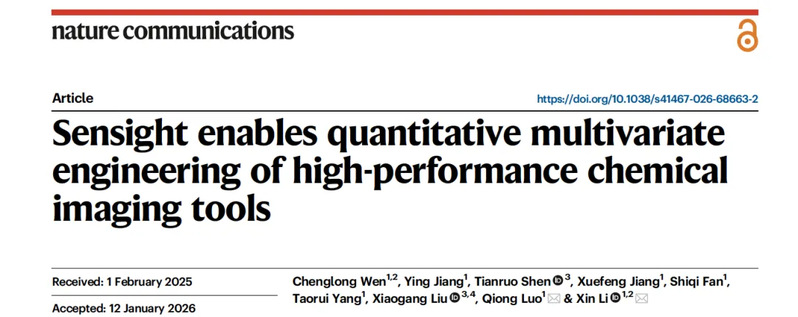
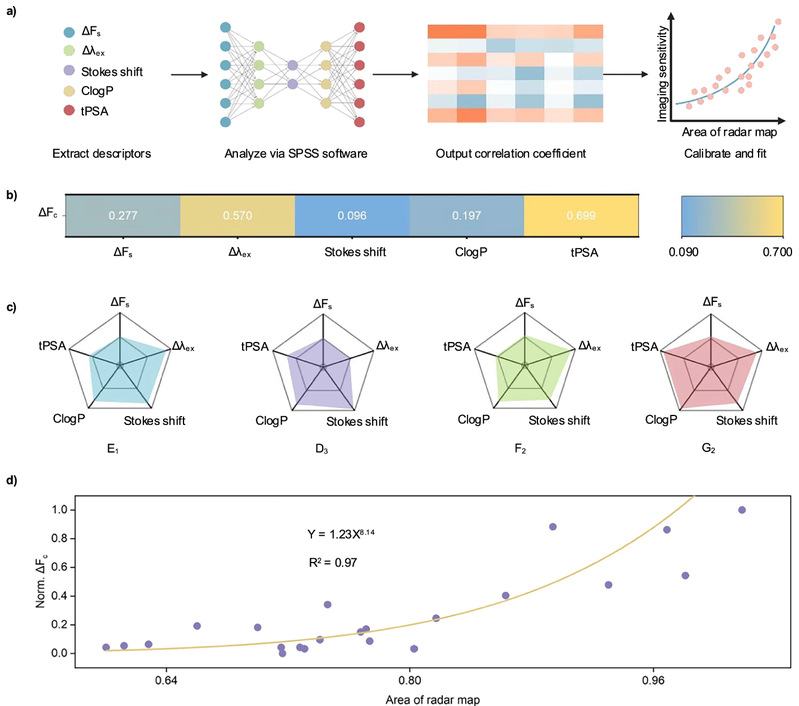
Recently, a research team led by Professor Xin Li from the School of Pharmacy Zhejiang University, in collaboration with partners, published a research paper titled "Sensight enables quantitative multivariate engineering of high-performance chemical imaging tools" in Nature Communications. The paper innovatively proposes a quantitative multivariate engineering model named Sensight, which, for the first time, systematically integrates the five key descriptors influencing the sensitivity of live-cell imaging, thereby enabling high-precision prediction and visual assessment of probe performance. This framework utilises multiple linear regression to integrate key probe descriptors—including topological polar surface area (tPSA), calculated lipid-water partition coefficient (ClogP), excitation wavelength matching (Δλex), fluorescence turn-on factor (ΔFs) and Stokes shift—into an intuitive radar plot. The radar plot area of the probe showed a strong correlation with the measured imaging sensitivity (R² = 0.97). Guided by Sensight, the team successfully designed the highly sensitive superoxide anion probe G3, which, compared to the commercially available probe DHE, can detect signal changes at lower concentrations under both physiological (epidermal growth factor stimulation) and pathological (paraquat-induced) conditions. When probe G3 was applied to stain mouse placental tissue under pathological PE conditions, it was found that the foetal side exhibited significantly higher levels than the maternal side. More importantly, the study further extended this framework to tetrazine-bicyclonine (Tz-BCN) bioorthogonal reactions and formaldehyde imaging systems, with predicted and measured results showing a high degree of agreement, demonstrating the immense value of this model as a versatile predictive framework.
The introduction of the Sensight model not only provides a robust theoretical basis and practical guidance for the rational design of chemical imaging tools, but also offers important insights for broader fields such as drug molecule design and nanomedicine delivery.
The School of Pharmacy Zhejiang University is the first-named institution in this paper. Chenglong Wen, a PhD student at the School of Pharmacy Zhejiang University, is the first author of this paper, whilst Professor Xin Li of the School of Pharmacy Zhejiang University, and Professor Qiong Luo of the School of Medicine Zhejiang University, are the co-corresponding authors.
Original link: https://www.nature.com/articles/s41467-026-68663-2
Student Research
-
27
2026.05
-
16
2026.05
-
06
2026.05
-
22
2026.04
-
20
2026.04
-
30
2026.03