


Published in Nature Communications! Team from SoPh, ZJU unveils LLM-based Universal 3D Generation Framework for Multi-Target Drug Development
Single-target drug design strategies often face problems such asdrug resistance, severe side effects and limited therapeutic efficacy in the treatment of complex diseases. Multi-target drugs offera key approach to tackling cancer, neurodegenerative diseases and other illnessesalike through the synergistic regulation of its multiple targets. Nonetheless, their designs need to satisfythe constraints of multiple binding pockets as well as drug-likeness simultaneously, placing extremely high demands on computational methodologies.
Current deep learning generative models have made remarkable progress in single-target drug research, yet they face three major limitations when extended to multi-target scenarios. First, most ligand-based methods rely heavily onthebioactivitydata of specific target pairs and show poor generalization ability. Second,reinforcement learning methods struggle to balance target specificity and chemical diversity, easily resulting inmonotonous molecular scaffolds. Lastly,diffusion models are computationally intensive and low in efficiency; their controllability of generation quality declines in complex scenarios, making them hardto be applied to the design of drugs targeting three or more targets.Large Language Models (LLMs) hold great potential in drug discovery, but existing models generally lack the ability to understand molecular 3D information, leaving a major research gap in the field of multi-target drug generation.
On April 11, the research team led by Tingjun Hou and Yu Kangfrom Zhejiang University, together with Huanxiang Liu’s team from Macao Polytechnic University, published the LaMGen model in Nature Communications. Built on the exclusive large-scale dataset MTD2025 — which contains over 600,000 quantum-precision molecular conformations and 730,000 multi-target association data entries—the LaMGenmodelinnovatively encodes ligand torsion angles into rotation-aware discrete tokens. With the self-developed TriCoupleAttention module, it can directly generate stable 3D active molecules with quantum precision merely based on protein sequences.In tests covering 20 target pairs, LaMGen outperformed existing mainstream models on 17 pairs, takingonly 0.44 seconds persingle generation. Moreover, under the zero-shot setting, the model can reproduce known active molecules, generate candidate compounds with novel scaffolds and better binding affinitywhilst supportingseamless expansion to three-target drug designs. This research provides an efficient AI engine for thedrug development of muti-target drugs against complex diseases.
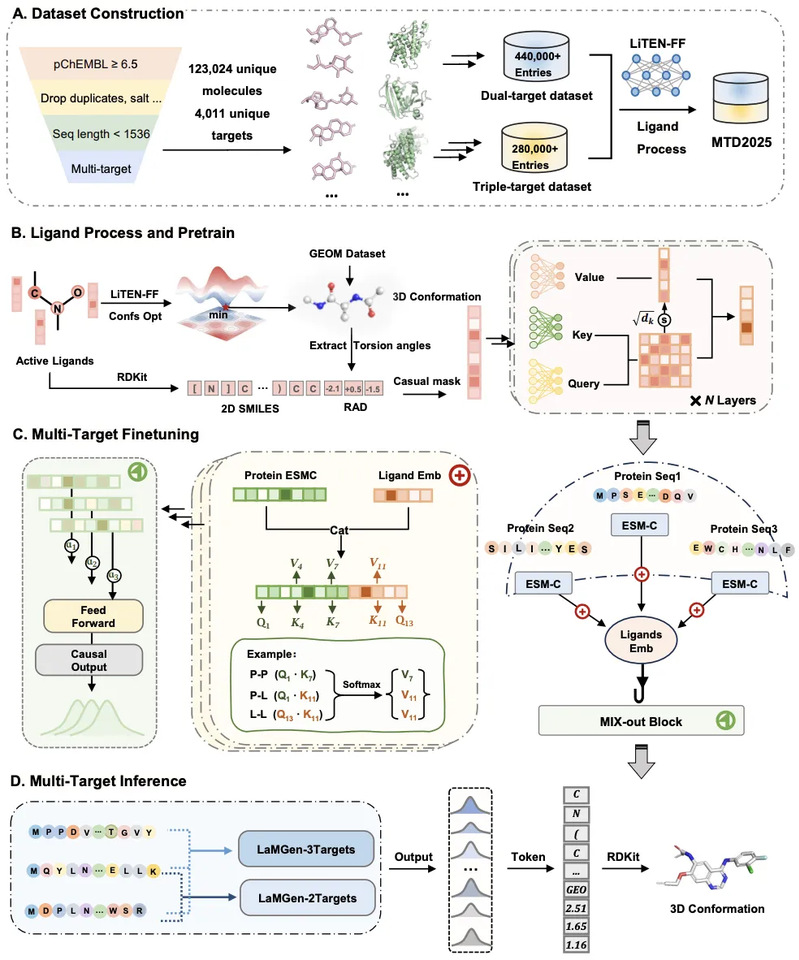
Figure 1. LaMGen Framework Diagram
The School of Pharmacy, Zhejiang University,is theprimary affiliationof thisthesis. Qun Su and Qiaolin Gou,PhD students from Zhejiang University and Macao Polytechnic University respectively, are joint first authors. Meanwhile associate Professor Yu Kangand Professor TingjunHoufrom Zhejiang University, together with Professor Huanxiang Liu from Macao Polytechnic University, serve as joint corresponding authors.

电话:0571-88208423 邮箱:zjucps@zju.edu.cn
地址:浙江省杭州市西湖区余杭塘路866号,浙江大学紫金港校区
Copyright © 2018 浙江大学药学院版权所有