
The team from the CPS-ZJU used chemical strategies to turn
2025-03-28 | 药学院英文网
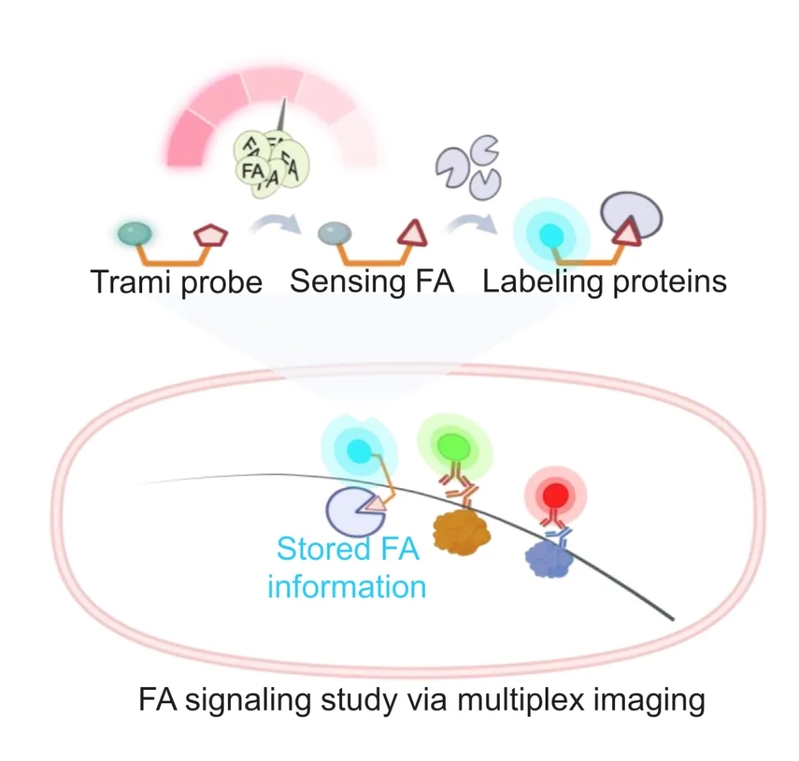
On March 24th, the research team led by Professor Xin Li from the CPS-ZJU published their latest findings in the Cell Biomaterials journal, which is published by Cell Press. The title of their paper was Activity-based trapping for multiplex imaging illuminates the hidden role of endogenous formaldehyde in proinflammatory signaling. In this study, the authors proposed a protein labeling strategy activated by formaldehyde, which can convert the transient and variable formaldehyde signals within cells into permanent protein tags; combined with multiple immunostaining, the signal mechanism of endogenous formaldehyde can be analyzed. The authors named this method Trapping for multiplex imaging and abbreviated it as Trami.
In recent years, active metabolites, as crucial signaling molecules regulating cellular functions, have attracted extensive attention. However, their transient nature makes it difficult for traditional detection methods to capture them, thus limiting the understanding of their pathophysiological mechanisms. Previously, Professor Xin Li and his collaborators employed an in - situ biological imaging strategy and found that the level of endogenous formaldehyde in the brain tissue of mice increased with age, and this phenomenon was particularly significant in Alzheimer's disease (AD) model mice. Meanwhile, the research team also discovered that promoting formaldehyde metabolism could improve the neurobehavior of AD mice. Nevertheless, how formaldehyde participates in the pathological development of AD remains unknown.
To address this, this study developed the Trami strategy. By combining the formaldehyde - triggered bioorthogonal reaction with fluorescence labeling technology, it achieved, for the first time, the conversion of transient formaldehyde signals in living cells into stable protein labels and enabled the dynamic analysis of formaldehyde spatiotemporal signals at the single - cell resolution. The study not only revealed a strong correlation between endogenous formaldehyde and inflammatory markers but also confirmed the decisive role of formaldehyde metabolism in the pro - inflammatory signaling pathway of microglia by regulating the formaldehyde - metabolizing enzyme ADH5. Moreover, the authors found that activated microglia were the main source of endogenous formaldehyde in the wild - type acute encephalitis mouse model. This research created the first molecular tool capable of stably capturing transient formaldehyde, revealed the potential of ADH5 as an anti - inflammatory target, and provided a new perspective for the drug development of diseases related to metabolic disorders.
NEWS
-
28
2026.07
-
17
2026.07
-
03
2026.07
-
08
2026.06
-
27
2026.05
-
15
2026.04