
The team from the CPS-ZJU published an article in Science Advances: Engineering cell-derived exosomes-encapsulated gel with disease microenvironment-responsive drug release properties for repairing spinal cord injuries
2025-04-06 | 药学院英文网
Spinal cord injury (SCI) is caused by traumatic or disease factors, resulting in structural damage to the spinal cord and dysfunction of nerve conduction. Global burden of disease research data shows that there are over 250,000 new cases of SCI each year, and its incidence, prevalence, and disability rate are increasing year by year, posing a significant challenge to the public health system. The pathological process of SCI, especially in the acute phase, is characterized by complexity and dynamic changes. Effective intervention in the microenvironment during the acute phase is conducive to subsequent tissue repair and functional recovery. Cells derived from mesenchymal stem cells (MSCs) and their extracellular vesicles (EVs) have multiple therapeutic activities such as reducing neural inflammation and promoting tissue repair, and are suitable for regulating the complex condition of SCI. Achieving the on-demand regulation of EVs' dynamic changes during the acute phase of SCI is the key to its repair effect.
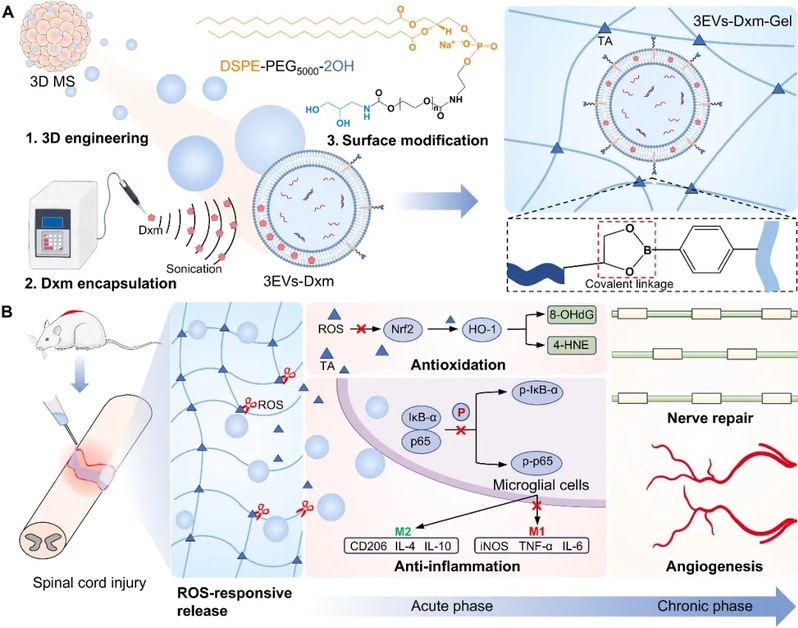
Recently, the team of Jianqing Gao from the CPS-ZJU, in collaboration with Zhen Gu's team and Shiqing Feng's team from Tianjin Medical University General Hospital, published a research paper titled An engineering-reinforced extracellular vesicle-integrated hydrogel with an ROS-responsive release pattern mitigates spinal cord injury in the journal Science Advances, and it was selected as the Featured Article of the current issue. This study successfully prepared 3EVs-Dxm (3 extracellular vesicles - dexamethasone) through three-dimensional culture technology and probe ultrasound method, which possess enhanced functions of promoting angiogenesis, promoting nerve repair, and inhibiting neural inflammation. Moreover, this study utilized the characteristics of high reactive oxygen species (ROS) in the SCI microenvironment and adopted membrane modification methods to modify the adjacent dihydroxy groups on the membrane of 3EVs-Dxm, attaching them to the hyaluronic acid modified with phenylboronic acid and cross-linking with tannic acid, forming an injectable hydrogel with ROS-responsive properties (3EVs-Dxm-Gel). The phenylboronic acid ester bond in 3EVs-Dxm-Gel can achieve effective loading of 3EVs-Dxm and ROS-responsive release, thereby alleviating oxidative damage and neural inflammation in the acute phase of SCI and creating a favorable microenvironment for subsequent tissue repair.
NEWS
-
28
2026.07
-
17
2026.07
-
03
2026.07
-
08
2026.06
-
27
2026.05
-
15
2026.04